Course authoring
Recourse vs Articulate 360
Articulate is a mature suite built around a slide canvas and a block editor. Recourse is a younger tool built around recordings of real software: a recording goes in, a simulation the learner can practise comes out, wrapped in a course and kept live in the LMS. They overlap less than the category name suggests. Where Articulate is better, this page says so, and every Articulate fact links to its source.
Updated
Facts checked on 29 October 2026 against each vendor's own pages.
Choose Articulate if your team designs custom interactions and branching scenarios, needs a stakeholder review workflow and a template library, and is buying an established suite per seat per year. Choose Recourse if your job is getting people able to use a piece of software before they need it, and you want a recording of the real system to become practice that stays current in the LMS.
Where each tool starts
Articulate starts from content that exists. Rise assembles a responsive course from blocks and templates; Storyline builds one slide at a time; the AI Assistant (now the Nova agent) drafts an outline, lesson or full course from a prompt or an uploaded document, and the October 2026 release added imports from Google Drive and OneDrive. That is the right design when the deck, policy or script is already written.
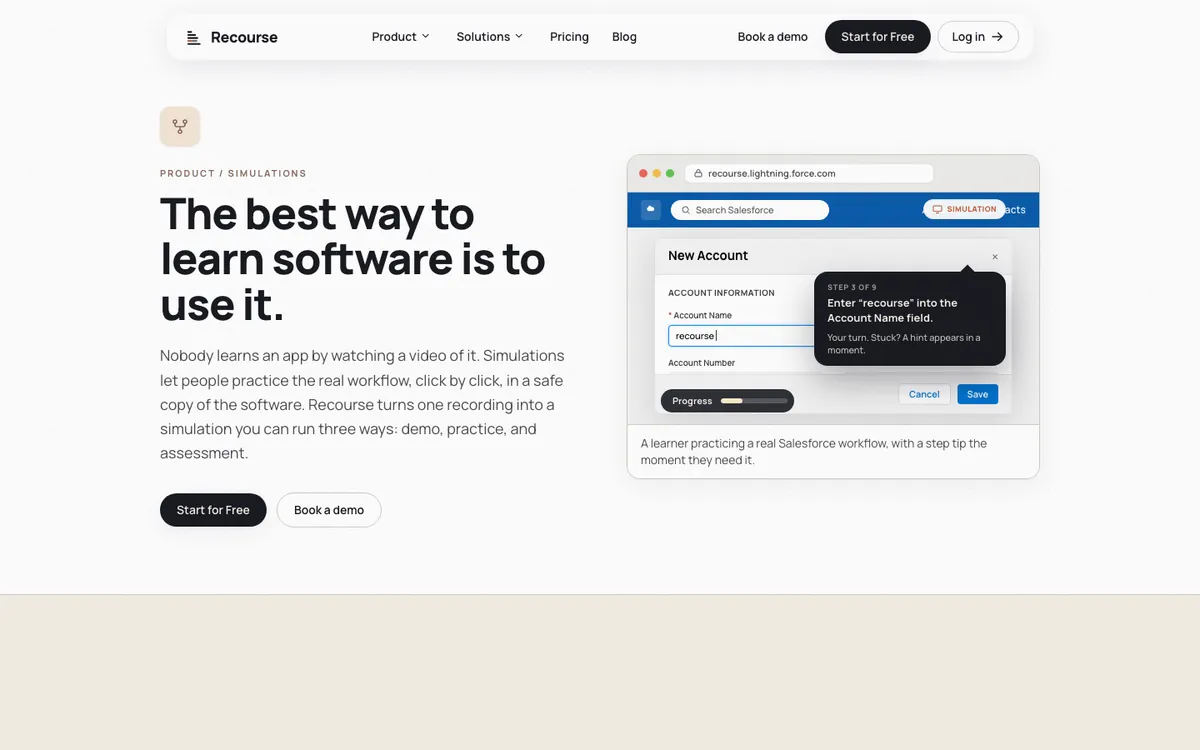
Recourse starts from a recording of the real system. Click through the task with the Chrome extension, which captures the screens, the clicks and the structure, or upload a recording you already have: a Loom, a Zoom share, a recorded UAT session, an old MP4. Recourse turns it into a simulation with three modes: Demo (a walkthrough that narrates itself), Practice (the learner does each step in a safe copy of the screens, with a hint if they stall) and Evaluate (a scored assessment with a pass mark that reports to the LMS). The simulation sits inside an editable course with modules, objectives and checks for understanding. The design assumption is that the most useful knowledge was never written down, which is true of most software rollouts and most hand-offs. For the simulation side alone, see Recourse vs Storyline.
Side by side
| Articulate 360 AI | Recourse | |
|---|---|---|
| Runs on | Rise in the browser; Storyline on Windows (Mac via Parallels or VMware) | Browser |
| Starting point | Prompt, document, blocks, slides | Recording of the real system, via the Chrome extension or any uploaded video; documents for courses |
| Software simulation | Storyline screen recording with View, Try and Test slides; modes fixed at insertion | Demo, Practice and Evaluate from one recording; hints when a learner stalls; Evaluate scored against a pass mark |
| Custom interactions | Storyline triggers, variables, branching; the strongest on the market | None; no canvas |
| LMS output | AICC, SCORM 1.2 and 2004, xAPI, cmi5 | SCORM and xAPI from Pro |
| Hosted package | Rise Connected Packages (Oct 2026); not advised for strict audit trails | Live SCORM on Team |
| Native LMS | Reach, 300 active learners a year included | None |
| Review workflow | Review 360, threaded comments, reviewers need no licence | Share a link; no threaded review comments |
| Translation | 80+ languages, credit-metered | Multilingual output from one source |
| AI from other tools | Integrations with Claude, ChatGPT, Copilot | Build and edit courses from Claude or ChatGPT over MCP (Solo and up) |
| Trial | 14 days | 30 days, full access including the Chrome extension, watermark only |
| Price | $1,449 or $1,749 per seat per year, annual only; credits $250 per 50,000 | Free for 30 days with full access; Solo, Pro and Team: pricing on request |
Where Articulate is clearly ahead
- Custom interactions. Storyline's trigger and variable system has no equivalent in Recourse. If your courses are built from scenarios, drag-and-drops and branching, there is nothing to compare.
- Maturity and ecosystem. Articulate was founded in 2002, counts 125,000 organisations and all of the Fortune 100 as customers, and has a community that has answered most questions already. Recourse has none of that history.
- Review and delivery. Review 360 and the Reach LMS are real products. Recourse shares links and pushes to your existing LMS; it does not try to be one.
- Standards breadth. Articulate publishes AICC and cmi5 as well as SCORM and xAPI. Recourse does SCORM and xAPI.
Where Recourse is ahead
- Undocumented knowledge. If the source is a 30-minute walkthrough from an SME or a recorded UAT session, Recourse turns it into a simulation and a course; Articulate needs someone to write it down first, or to prompt the AI and then check it against reality.
- Simulations without authoring. Storyline's Try and Test modes are built from a recording too, but you then edit hotspots slide by slide, and a mode cannot be converted after insertion. Recourse generates Demo, Practice and Evaluate from one recording and hints the learner when they stall.
- Self-serve start. The free 30 days include full access and the Chrome extension, with no AI credits to track; Articulate's trial is 14 days.
- Platform. Everything runs in a browser, on any operating system.
What Recourse does not do
- No overlay on the live application and no in-app guidance.
- No branching yet: each simulation follows one right path. Branching is on the roadmap.
- No LTI, cmi5 or AICC output.
- No native LMS.
- No threaded review comments.
- Desktop applications only through an uploaded video.
There is also no slide canvas or trigger system, so custom interactions stay in Storyline. If any of those is a hard requirement, Articulate or another tool on our alternatives list is the better choice.
Pricing in detail
Articulate 360 AI Teams is $1,749 per seat per year and Personal is $1,449, both billed annually. The Frontline tier starts at $500 a year for unlimited seats but excludes Storyline and Rise. Avatars, translation and training kits draw credits at $250 per 50,000, and credits expire at the end of the term. A promotional price of $1,198 was shown on the day we checked.
Recourse is free for 30 days with full access, Chrome extension included, with a watermark on output; nothing is deleted at the end. Solo, Pro and Team: pricing on request. Solo is for courses shared by a Recourse link, with AI-assisted authoring and MCP, and no SCORM export. Pro adds simulations, the Chrome extension, and static SCORM and xAPI export. Team is three seats with unlimited simulations, live SCORM.
Frequently asked questions
Is Recourse a Storyline replacement?
How do the prices compare?
Do both update a published SCORM course without a re-upload?
Can Recourse import Storyline or Rise courses?
How we checked
Articulate's facts were read from the linked pages on 29 October 2026. Recourse's facts come from our own pricing page and product. Corrections to hello@recoursehq.com.
- Articulate 360 pricing, What's new, October 2026, Storyline 360, Review 360, Reach, About Articulate
- Storyline step-by-step slides: View, Try and Test
- Recourse pricing and Recourse simulations
Related
Last checked 29 October 2026. Articulate's prices and features are taken from its public pages and can change.